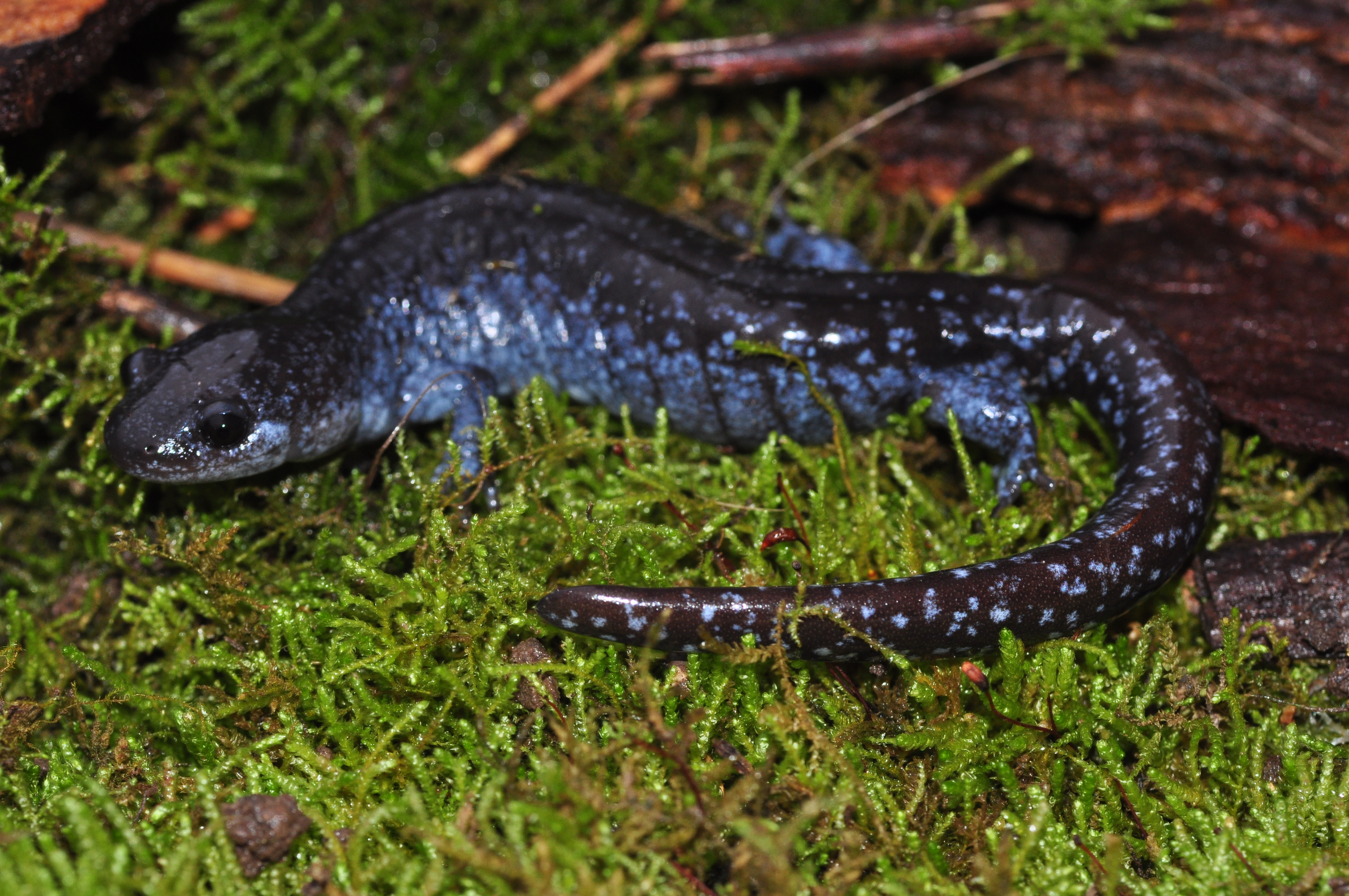
 Small-mouthed Salamander
AMPHIBIA (Amphibians) CAUDATA (Salamanders) AMBYSTOMATIDAE (Mole Salamanders)
Small-mouthed Salamander
Ambystoma texanum
(Matthes 1855)
ăm-bĭs-tō-mă — tĕx-ā-nŭm
Conservation Status:
State: None
Federal: None
NatureServe State: S5 - Secure
NatureServe National: N5 - Secure
NatureServe Global: G5 - Secure
CITES: None
Diagnosis:
This is Nebraska’s smallest salamander reaching a total length between 4.0-5.5 inches (10.1-14.0 cm). Ground color is olive green to brown, and many specimens are speckled with metallic grayish-blue, silver, or bronze-colored flecks especially along the sides. The head is disproportionately small for the body as is the mouth, and the lower jaw usually protrudes slightly past the upper jaw. Limbs and toes are relatively short when compared to other Nebraska salamanders. Larvae can be differentiated from Tiger Salamander larvae by the presence of pigment on their chin. Tiger Salamander larvae lack such pigment.
Distribution:
This species of salamander is found from extreme southeast Michigan and western Ohio south through western Alabama and west through southeast Nebraska south through eastern Texas. It is absent from highland areas of south-central Missouri and north-central Arkansas. In Nebraska the Small-mouthed Salamander barely enters the state and is only found in eastern Sarpy, Cass, Otoe, Nemaha, and Richardson Counties. It is considered rare in Nebraska and cannot be collected without a permit.
(, Museum Voucher) (, Observation) (, Literature Record) (, iNat Record), ( Fossil)
Open icons are questionable records; Click on a marker to view details.
Full range depicted by light shaded red area.
Export Google Earth (.kml)
-
Occurrence Summary:
-
11
Records
-
11
Museum Vouchers
-
0
Other Observations
Some county occurrences indicated below may be too imprecise to map above.
County Breakdown: County Name (# occurrences):
Nemaha (8); Richardson (2); Sarpy (1);
Natural History:
Throughout most of its range the Small-mouthed Salamander occupies a diverse array of habitat types from wet woodlands to wet prairies and even ditches adjacent to agricultural fields. In Nebraska ephemeral pools within or at edges of woodlands are the most common habitats occupied by this salamander. Crayfish burrows along edges of temporary and small permanent wetlands are used during winter and summer to escape temperature extremes. Breeding takes place in fishless temporary ponds, roadside ditches, and semi-permanent wetlands either within woodlands or at woodland edges. Small-mouthed Salamanders are the earliest amphibians to emerge after winter hibernation. They often enter ponds and pools shortly after first ice melt in late February and early March. Rainy weather triggers their migration from winter hibernacula – usually from crayfish burrows along wetland edges. Their first order of business is breeding, which takes place over a couple of days once the wetlands fill with water. Males deposit a spematophore on a submerged structure that females pick up shortly after. Females then lay hundreds of eggs either individually or in small clusters. Subsequent rain events trigger additional breeding aggregations, but breeding activity probably halts after mid- to late April. Adults return to a subterranean life after breeding where they feed on worms and other invertebrates. Larvae hatch after 2-3 weeks, feed on aquatic invertebrates for 3-4 months, and metamorphose into small terrestrial salamanders by late July and August.
Account Last Updated:
2/20/2020 4:57:17 PM - page took 0.1034185 seconds to load.