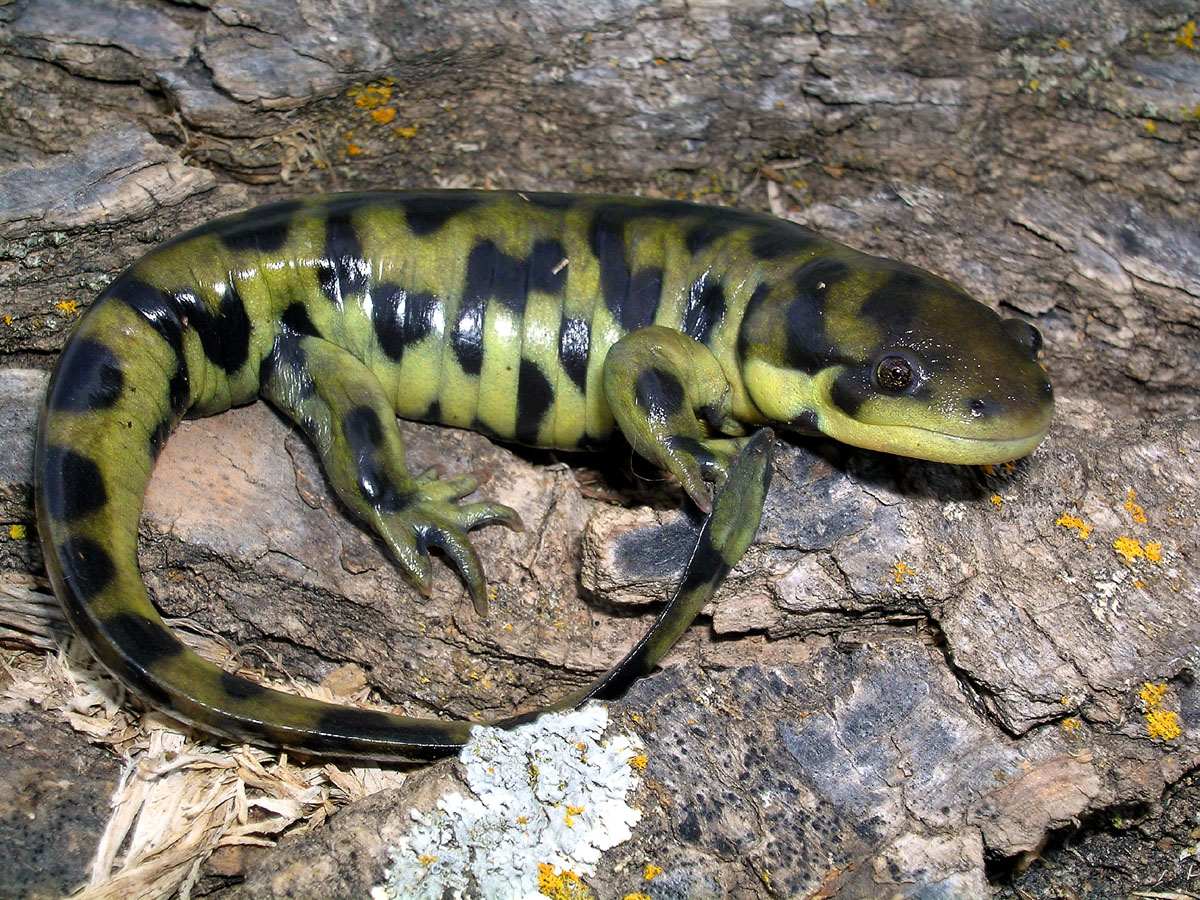
 Western Tiger Salamander
AMPHIBIA (Amphibians) CAUDATA (Salamanders) AMBYSTOMATIDAE (Mole Salamanders)
Western Tiger Salamander
Ambystoma mavortium
Baird 1850
ăm-bĭs-tō-mă — mă-vŏr-tē-ŭm
Conservation Status:
State: None
Federal: None
NatureServe State: S5 - Secure
NatureServe National: N5 - Secure
NatureServe Global: G5 - Secure
CITES: None
Diagnosis:
Depending on the location in Nebraska, Western Tiger Salamanders can exhibit one of at least two variants of different color and pattern. In the southern portion of the state, Barred Tiger Salamanders have clearly defined, often vibrant yellow bars that extend from the sides to the dorsum. Ground color is mostly black or very dark green or gray. In the Sand Hills and in the northwestern counties, the black ground color is greatly reduced and appears mostly as a net-like or reticulated pattern weaving throughout a series of olive green to pale yellow blotches. This is where the name of this variant – the Blotched Tiger Salamander – is derived. Although an all greenish-gray variant with a reduced pattern exists just north into South Dakota, this variant has not been found in the wild in Nebraska. NOTE: Given that salamanders are often purchased as bait species, many public fishing ponds and lakes may contain salamanders that are atypical for the region. Average length is 6.0-8.0 inches (15.2-20.3 cm.) but neotenic, paedomorphic individuals – those that maintain their larval characteristics into adulthood and remain aquatic for life – may grow substantially larger.
Distribution:
Western Tiger Salamanders occur throughout the Great Plains from the Canadian plains south through Texas and west to the foothills of the Rocky Mountains. A disjunct population exists in eastern Washington and northern Idaho. In Nebraska Western Tiger Salamanders are found statewide and are fairly common. They are regulated as a bait species.
(, Museum Voucher) (, Observation) (, Literature Record) (, iNat Record), ( Fossil)
Open icons are questionable records; Click on a marker to view details.
Full range depicted by light shaded red area.
Export Google Earth (.kml)
-
Occurrence Summary:
-
1,164
Records
-
1,164
Museum Vouchers
-
0
Other Observations
Some county occurrences indicated below may be too imprecise to map above.
County Breakdown: County Name (# occurrences):
Adams (8); Antelope (1); Arthur (17); Banner (3); Blaine (4); Boone (3); Box Butte (8); Boyd (1); Brown (48); Buffalo (7); Burt (1); Butler (9); Cass (3); Cedar (28); Cherry (115); Cheyenne (137); Clay (10); Colfax (1); Cuming (2); Custer (4); Dakota (4); Dawes (69); Deuel (4); Dixon (39); Douglas (11); Dundy (8); Fillmore (5); Franklin (1); Furnas (4); Gage (4); Garden (21); Garfield (5); Grant (16); Greeley (3); Harlan (17); Holt (5); Hooker (1); Jefferson (4); Johnson (4); Kearney (2); Keith (101); Kimball (2); Knox (1); Lancaster (73); Lincoln (32); Logan (1); Loup (5); Madison (5); McPherson (3); Merrick (1); Morill (1); Morrill (3); Nance (6); Nemaha (1); Otoe (5); Pawnee (2); Perkins (9); Pierce (3); Platte (8); Polk (2); Richardson (2); Rock (4); Saline (10); Sarpy (1); Saunders (16); Scotts Bluff (8); Seward (3); Sheridan (3); Sherman (160); Sioux (31); Stanton (1); Thayer (6); Thomas (3); Valley (2); Washington (3); Wayne (2); Webster (5); Wheeler (2); York (1);
Natural History:
Any permanent or semi-permanent bodies of water can be potential habitat for Western Tiger Salamanders. Fishless ponds are preferred and necessary for the species to persist in an area. This species is well-adapted to arid grasslands of the Great Plains. In the west they are known to inhabit prairie dog burrows where they take cover during the day and emerge at night to forage. Western Tiger Salamanders begin their active season when early spring rains begin by migrating between winter habitats and breeding ponds. Although most activities are nocturnal, occasional daytime movements may be made when climatic conditions allow. Once breeding commences it is not long before fishless ponds and even stock tanks are saturated with adults. After hatching larvae become voracious predators and feed on anything they can catch – including other salamander larvae. In parts of Nebraska where there are permanent ponds, this species may produce larvae that are paedomorphic and cannibalistic. Cannibalistic forms are often easily identified due to their exceptionally large body size and a somewhat comical enlarged head.
Account Last Updated:
2/20/2020 5:02:53 PM - page took 0.3427576 seconds to load.